

Speech & audio AI · Original project
ForgeGuard Kokoro Server
Container-native, OpenAI-compatible text-to-speech built around the Kokoro-82M model, engineered for real hardware and observable operations.
- Status
- Active
- License
- Apache-2.0
- Latest release
- v1.1.0
- Model
- Kokoro-82M
Overview
What it solves.
ForgeGuard Kokoro Server exposes an OpenAI-style /v1/audio/speech endpoint so any OpenAI SDK or compatible client can synthesize speech against local hardware. It solves the operational half of self-hosted TTS: images with weights baked in, health and readiness endpoints designed for orchestrators, optional bearer authentication, built-in HTTPS, and GPU telemetry for the bundled web console.
Distribution is deliberately narrow — container images and a Helm chart only. There is no supported bare-metal install path, which keeps the deployment story reproducible on both x86_64 CUDA workstations and Jetson Orin edge devices.
Verified capabilities
What it does.
- OpenAI-compatible speech APIPOST /v1/audio/speech with streaming responses in mp3, wav, opus, flac, and raw 16-bit 24 kHz PCM; point any OpenAI SDK at the server.
- Multi-language synthesisEnglish (US/GB), Spanish, French, Hindi, Italian, Japanese, Brazilian Portuguese, and Mandarin Chinese via the Kokoro-82M model.
- Voice mixing and voicepacksWeighted voice combinations like af_bella(2)+af_sky(1), with /v1/audio/voices/combine to persist a blend as a reusable voicepack.
- Timestamped captions and phoneme control/dev/captioned_speech returns word-level timestamps; /dev/phonemize and /dev/generate_from_phonemes give IPA-level input and output control.
- Warmup-aware health contractThe server accepts connections immediately while the model warms in the background; /health, /ready, and Retry-After semantics keep orchestrator probes accurate, and a failed warmup exits non-zero instead of lingering unhealthy.
- Optional bearer authentication and built-in HTTPSA single API_KEY environment variable gates API routes; TLS_ENABLED=true serves HTTPS directly with an auto-generated, persisted self-signed certificate by default.
- Inline pause and pronunciation tokens"[pause:1.5s]" inserts silence and "[Worcester](/wˈʊstər/)" overrides pronunciation with IPA, parsed server-side during synthesis.
- Long-form chunkingInput is split and stitched at sentence boundaries with configurable token bounds, compensating for the model's ~30-second tuning window.
Operational facts
The operating contract.
| API contract | OpenAI-style /v1 routes; supporting endpoints under /dev and /debug; interactive reference at /docs |
|---|---|
| Runtime | Python/FastAPI server; model warms in a background task; CPU fallback via USE_GPU=false |
| Distribution | Container images (ghcr.io) + Helm chart; no supported bare-metal install |
| Authentication | Optional bearer token via API_KEY; /health, /ready, /system, and the console stay open |
| Health / readiness | /health liveness and /ready readiness with warming semantics and Retry-After; failed warmup exits non-zero |
| Observability | GPU/activity telemetry at /system; /debug/threads, /debug/storage, /debug/system |
| Persistence | Generated audio and TLS material under OUTPUT_DIR; weights baked into images |
| Supported hardware | NVIDIA RTX 3000–5000 (x86_64, CUDA cu128) and Jetson Orin (arm64, JetPack 6) |
Evidence
Console and request contract.
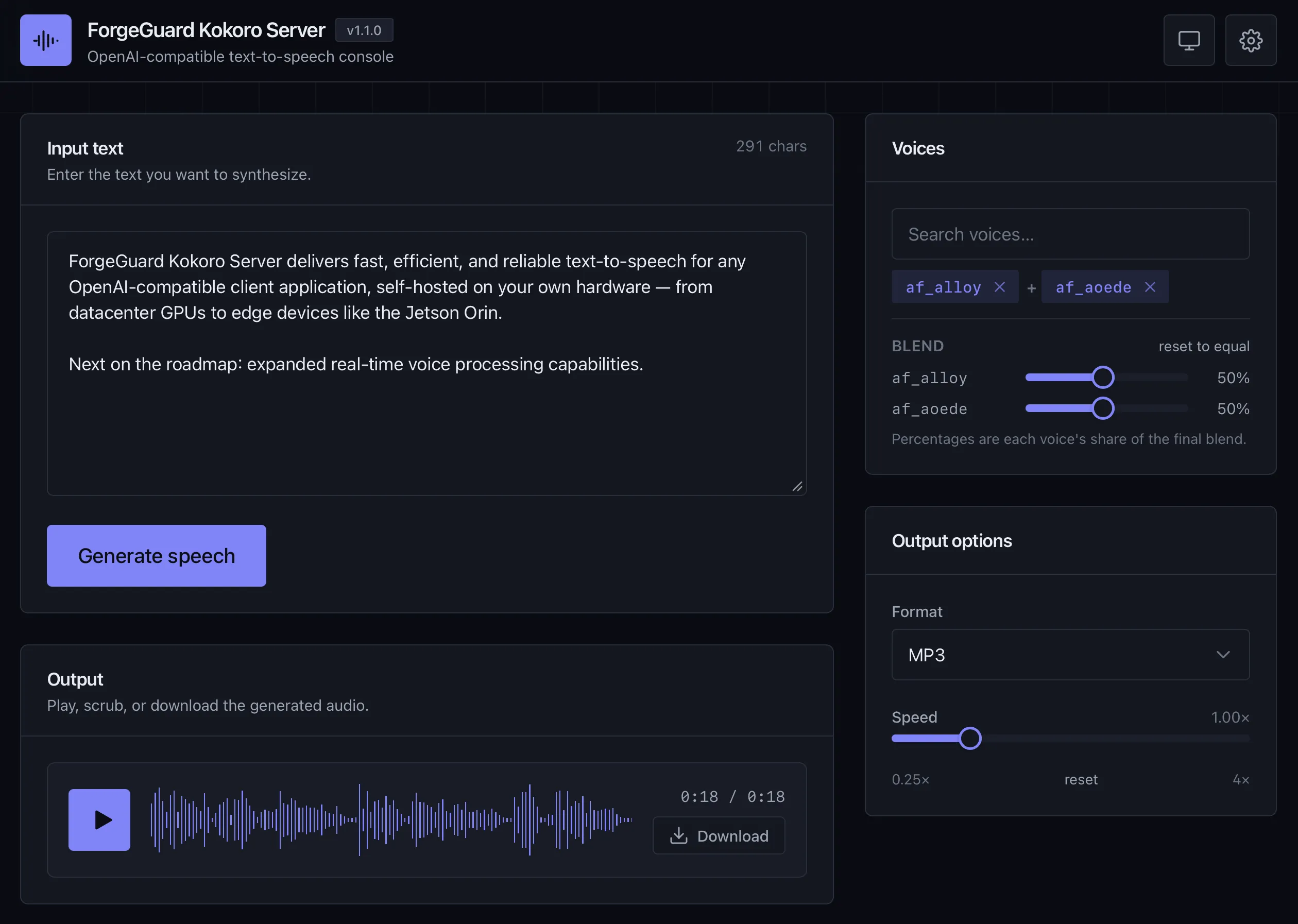
Synthesize speech with curl
curl -X POST http://localhost:8880/v1/audio/speech \
  -H 'Content-Type: application/json' \
  -d '{"model":"kokoro","input":"Hello world!","voice":"af_heart","response_format":"mp3"}' \
  -o hello.mp3
/health returns 200 immediately (status "warming" then "healthy"); /ready returns 200 once the model can synthesize.
Architecture
Data flow.
Clients speak the OpenAI API to a FastAPI interface layer that handles auth, queuing, and format negotiation; inference runs on local GPU compute with health and telemetry surfaced alongside.
Deployment
Deployment paths.
Docker (x86_64 CUDA)
docker run -d --name kokoro --gpus all -p 8880:8880 \
  ghcr.io/forgeguard-ai/kokoro-server:latest
RTX 3000–5000 series; pin a release tag such as :1.1.0 for stable deployments.
Docker (Jetson Orin)
docker run -d --name kokoro --runtime nvidia -p 8880:8880 \
  ghcr.io/forgeguard-ai/kokoro-server-jetson:latest
arm64 image for JetPack 6 devices.
Docker Compose
docker compose -f docker/gpu/docker-compose.prod.yml up -dOffline-capable pull-and-run stack; docker-compose.local.yml adds TLS on 8443.
Kubernetes (Helm)
helm install kokoro oci://ghcr.io/forgeguard-ai/charts/kokoro-server --version 1.1.0Probes wire the health contract in: startup/readiness on /ready, liveness on /health; GPU scheduling via nvidia.com/gpu limits; API keys from a Kubernetes Secret.
Compatibility
Support matrix.
| Target | Status | Notes |
|---|---|---|
| NVIDIA RTX 3000–5000 series (x86_64) | Supported | CUDA cu128 image; ghcr.io/forgeguard-ai/kokoro-server |
| NVIDIA Jetson Orin (arm64) | Supported | JetPack 6 image; ghcr.io/forgeguard-ai/kokoro-server-jetson |
| CPU-only hosts | Supported (reduced performance) | USE_GPU=false runs CPU inference in the cu128 image |
| AMD (ROCm), Intel | Planned | Tracked on the roadmap; no images published yet |
Responsibility
Security and responsible use.
- Optional bearer authentication via API_KEY; health, readiness, and telemetry endpoints remain open for orchestrators.
- Built-in HTTPS with an auto-generated self-signed certificate for local use; supply a CA-issued certificate for anything public.
- The repository publishes synthetic-media guidance in docs/responsible-use.md and its security posture in docs/security.md.
Lineage & attribution
Where this work comes from.
An independent ForgeGuard AI server, originally derived from remsky/Kokoro-FastAPI. Licensed Apache-2.0 with required attributions in NOTICE.
- remsky/Kokoro-FastAPIApache-2.0
The original Dockerized FastAPI wrapper this project builds on.
- Kokoro-82M (hexgrad)Apache-2.0
Model weights, with the kokoro and misaki libraries.
- StyleTTS2MIT
Inference code adapted from the StyleTTS2 project.
Status & limitations
Known limitations and roadmap.
- SSML is not supported; only the documented inline pause and IPA pronunciation tokens are parsed.
- Text normalization can occasionally drop or rewrite phrases; it can be disabled per request with normalization_options.
- WAV responses use streaming-sentinel size fields that Python's stdlib wave module misreads; use soundfile or ffprobe for exact durations.
- AMD (ROCm) and Intel images are planned but not yet published.
Roadmap
- Real-time voice endpointsLow-latency incremental synthesis over persistent connections (WebSocket/SSE) with barge-in-friendly cancellation, alongside the existing request/response endpoints.
- More inference backendsAMD (ROCm) and Intel images as hardware becomes available to validate on.
Full history in the changelog; planned work is tracked in the repository roadmap.
Documentation
Read the docs.
Versioned documentation for Kokoro Server is published from the repository'sdocs/site/ tree.