ForgeGuard Faster Whisper Server
ForgeGuard Faster Whisper Server
Section titled “ForgeGuard Faster Whisper Server”A container-native, OpenAI-compatible speech-to-text server built on faster-whisper and CTranslate2. Point any OpenAI audio SDK at it and transcribe or translate on hardware you control — nothing about a request leaves the container.
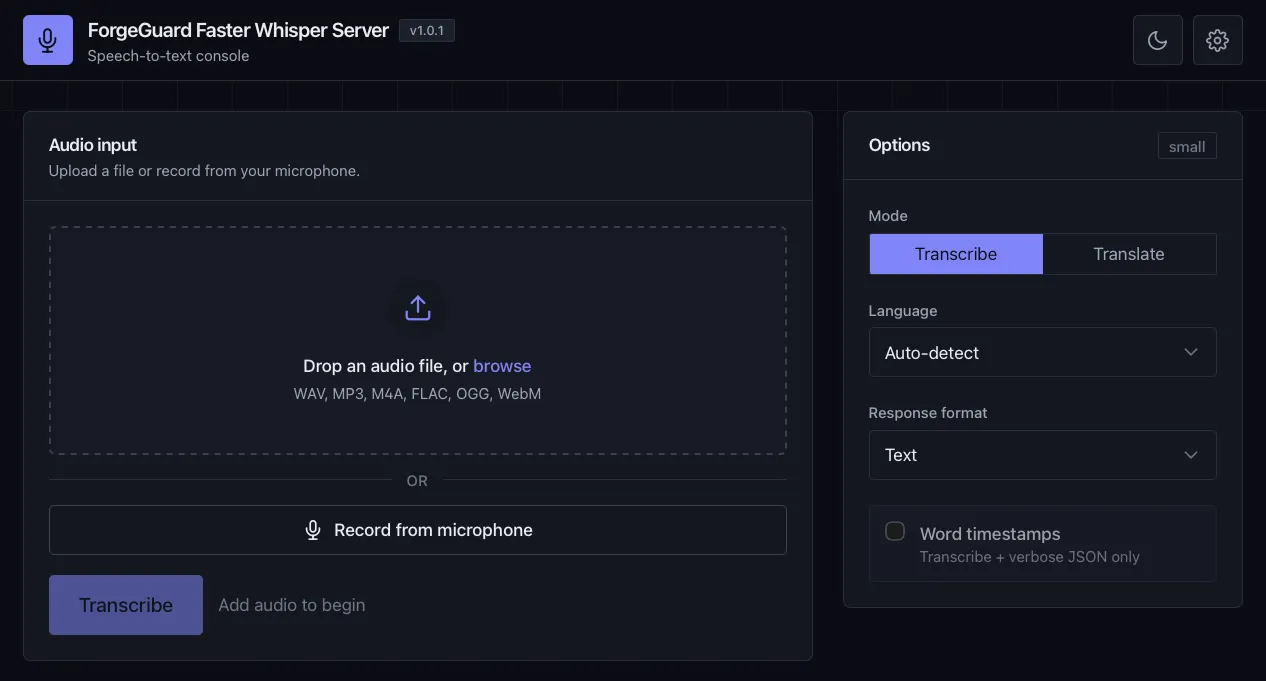
What it is
Section titled “What it is”- An HTTP service exposing
/v1/audio/transcriptionsand/v1/audio/translations, plus a small set of operational and admin routes. - Distributed as container images and a Helm chart only — there is no supported bare-metal install path.
- Published for x86_64 NVIDIA GPUs (CUDA cu128) and NVIDIA Jetson Orin (JetPack 6), each baking a default Whisper model so there are no downloads at container start.
- Conservative with sensitive data by default: transcripts stay out of the logs, and uploaded audio lives only in a per-request temporary file.
Where to start
Section titled “Where to start”Run it
Section titled “Run it”- Quickstart — run a container, verify health and readiness, and make your first transcription request.
- Container deployment — the single-container path with volumes, GPU flags, and environment.
Integrate it
Section titled “Integrate it”- Transcription and translation — how the endpoints, formats, and options behave.
- OpenAI-compatible API reference — endpoints, parameters, and response schemas with examples.
- Compatibility — what “OpenAI-compatible” means here, and where it differs from the OpenAI service.
Operate it safely
Section titled “Operate it safely”- Health and readiness — the liveness and readiness contract for orchestrators.
- Observability and queues — the
/systemtelemetry and the admission queue. - Security hardening — authentication, TLS, upload limits, and container hardening.
- Privacy and responsible use — how audio and transcripts are handled, and your obligations as an operator.
Understand models and data handling
Section titled “Understand models and data handling”- Model selection — choose, provision, activate, and persist a Whisper model.
- Architecture overview — components, request lifecycle, and model lifecycle.
Deployment methods
Section titled “Deployment methods”| Method | Intended use | Guide |
|---|---|---|
| Container | Local testing and single-service deployment | Container |
| Docker Compose | Durable single-host operation | Compose |
| Portainer | Managed remote Docker environments | Portainer |
| Kubernetes (Helm) | Cluster and production deployment | Kubernetes |
| Jetson Orin | Edge / on-device deployment | Hardware profiles |
Project status
Section titled “Project status”Current release 1.1.0. Versioned releases and immutable container tags are
recommended for persistent deployments; :latest tracks the newest stable
release. Real-time streaming and additional inference backends (AMD ROCm, Intel)
are planned but not yet available. See Upgrades
for the release and tagging policy.