Agent systems · Maintained fork
ForgeGuard Hermes Agent
A ForgeGuard-maintained distribution of Hermes Agent — the self-improving AI agent by Nous Research — packaged as versioned runtime and CLI container images and desktop installers.
- Status
- Active
- License
- MIT
- Upstream
- NousResearch/hermes-agent
- Language
- Python
Overview
What it solves.
Hermes Agent is the self-improving AI agent built by Nous Research. It creates skills from experience and improves them during use, curates its own memory, searches its past conversations, and builds a model of who you are across sessions. It runs on a small VPS, a GPU cluster, or serverless infrastructure, and you can reach it from Telegram, Discord, Slack, WhatsApp, or Signal while it works on a remote machine. Use any model provider and switch with a single command.
ForgeGuard maintains a distribution of that product. It syncs to upstream tagged releases and adds a packaging and release overlay: versioned runtime-* and cli-* container images on GitHub Container Registry, plus Linux and macOS desktop installers attached to each fork release. ForgeGuard does not change how the agent behaves — it packages and ships it. The runtime image keeps an immutable install tree at /opt/hermes separate from a durable state volume at /opt/data, so upgrading is pulling a newer tag and recreating the container while configuration, sessions, memory, and skills persist.
Verified capabilities
What it does.
- Self-improving skillsCreates skills from experience and improves them during use. (Upstream product.)
- Persistent memory and recallCurates its own memory and searches its past conversations. (Upstream product.)
- User modelingBuilds a model of who you are across sessions. (Upstream product.)
- Runs anywhere, cheaplyA small VPS, a GPU cluster, or serverless infrastructure that costs nearly nothing when idle. (Upstream product.)
- Reachable from chat appsTalk to it from Telegram, Discord, Slack, WhatsApp, or Signal. (Upstream product.)
- Any model providerUse any model provider and switch with a single command. (Upstream product.)
- Versioned runtime and CLI imagesImmutable runtime-* and cli-* GHCR tags tied to a specific upstream base. (ForgeGuard overlay.)
- Desktop installersLinux (.AppImage/.deb/.rpm) and macOS (.dmg/.zip, ad-hoc signed, not notarized) builds attached to each fork release. (ForgeGuard overlay.)
- Durable, separable stateA /opt/data state volume kept separate from the immutable /opt/hermes install tree, with s6-overlay supervision. (ForgeGuard overlay.)
Operational facts
The operating contract.
| Distribution | runtime-* and cli-* images on ghcr.io/forgeguard-ai/hermes-agent; immutable version and git-sha tags plus rolling latest; linux/amd64 |
|---|---|
| Runtime image | A persistent, s6-overlay-supervised dashboard and per-profile gateways on port 9119; durable state on /opt/data |
| CLI image | A lean interactive build for distrobox with host integration and durable state in your home directory |
| Desktop installers | Linux .AppImage/.deb/.rpm and macOS .dmg/.zip (ad-hoc signed, not notarized), attached to each fork release |
| Upstream base | Tracks upstream tagged releases; current base v2026.7.1 (Hermes 0.18.0), recorded in the FORK_UPSTREAM_BASE marker |
| Authentication | Dashboard authentication is required on non-loopback binds |
| Security boundary | Whole-process / OS isolation (container and host); ForgeGuard does not weaken the upstream model |
Evidence
The Hermes dashboard.
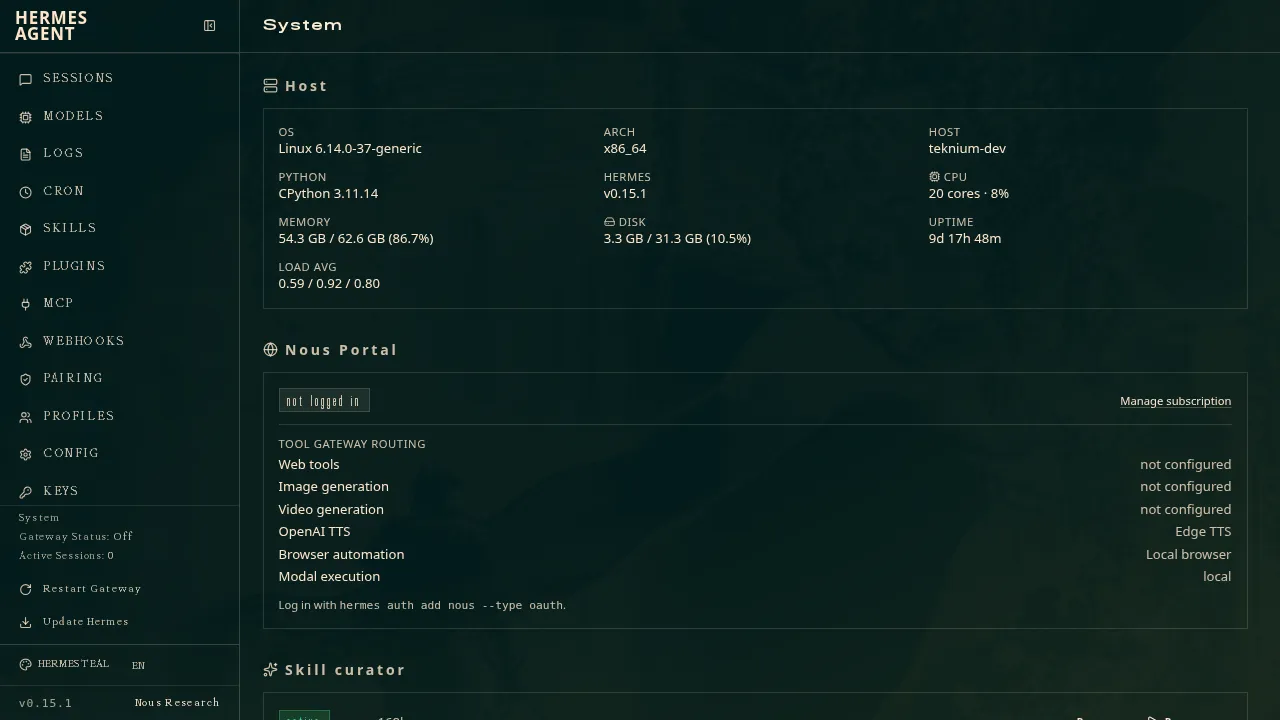
Run a persistent Hermes server
docker run -d --name hermes --restart unless-stopped \
  -v ~/.hermes:/opt/data -p 9119:9119 \
  -e HERMES_DASHBOARD=1 \
  ghcr.io/forgeguard-ai/hermes-agent:runtime-<release> gateway run
curl --fail http://localhost:9119/api/status
Dashboard authentication is required on non-loopback binds; configure basic-auth credentials before exposing the server. State on ~/.hermes is durable, so upgrading is pulling a newer tag and recreating the container.
Architecture
Data flow.
Client channels — the CLI and TUI, the desktop app's Client Mode, and messaging platforms — all reach the agent through the dashboard/gateway backend on port 9119. That backend drives the agent runtime, which calls tools (including a bundled browser) and whichever model providers you configure. Durable state lives on the mounted /opt/data volume, separate from the immutable /opt/hermes install tree, with s6-overlay supervising the services.
Deployment
Deployment paths.
Runtime image (server)
docker run -d --name hermes -v ~/.hermes:/opt/data -p 9119:9119 \
  -e HERMES_DASHBOARD=1 \
  ghcr.io/forgeguard-ai/hermes-agent:runtime-<release> gateway run
A persistent, supervised server with a web dashboard and durable state.
CLI image (distrobox)
distrobox create --image ghcr.io/forgeguard-ai/hermes-agent:cli-latest --name hermes
distrobox enter hermes
An interactive terminal install with host integration; prefer an immutable cli-<release> tag for a stable environment.
Desktop installers
chmod +x Hermes-*.AppImage
./Hermes-*.AppImage
Prebuilt Linux (.AppImage/.deb/.rpm) and macOS (.dmg/.zip) builds of the Hermes Desktop app, attached to each fork release.
Upstream native installer
# https://hermes-agent.nousresearch.com/docs/getting-started/quickstartThe canonical, fully upstream-supported way to install Hermes directly on your machine.
Compatibility
Support matrix.
| Target | Status | Notes |
|---|---|---|
| linux/amd64 (containers) | Supported | runtime-* and cli-* images; ghcr.io/forgeguard-ai/hermes-agent |
| Linux desktop | Supported | .AppImage / .deb / .rpm installers attached to each release |
| macOS desktop | Supported | .dmg / .zip, ad-hoc signed and not notarized |
| Upstream base | Tracks v2026.7.1 | Hermes product version 0.18.0; recorded in FORK_UPSTREAM_BASE |
Responsibility
Security and responsible operation.
- Dashboard authentication is required on non-loopback binds; configure basic-auth credentials before exposing the server.
- The meaningful security boundary for untrusted input is whole-process / OS isolation (container and host); ForgeGuard does not weaken the upstream model.
- The agent can drive tools including a bundled browser and calls the model providers you configure; run it with least privilege.
- macOS desktop builds are ad-hoc signed and not notarized. Report suspected vulnerabilities via SECURITY.md, not public issues.
Lineage & attribution
Where this work comes from.
A ForgeGuard AI maintained distribution of NousResearch/hermes-agent, the self-improving AI agent by Nous Research. The agent runtime, providers, tools, messaging gateway, and desktop app are upstream-owned; ForgeGuard adds a packaging and release overlay only. Licensed MIT, copyright Nous Research, with attribution preserved. ForgeGuard does not claim upstream sponsorship or endorsement of its distribution-specific builds.
- NousResearch/hermes-agentMIT
The upstream Hermes Agent product — runtime, tools, gateway, and desktop app.
- Hermes documentation (Nous Research)Reference
The authoritative documentation for how the agent itself works.
Status & limitations
Known limitations.
- Container images are built for linux/amd64 only.
- macOS desktop builds are ad-hoc signed and not notarized.
- ForgeGuard ships and versions the upstream product without changing agent behavior; features and support for the agent itself come from upstream.
- The fork advances quickly and tracks upstream tagged releases; confirm against the FORK_UPSTREAM_BASE marker and the newest release before pinning.
Release history is published on the repository releases page.
Documentation
Read the docs.
Versioned documentation for Hermes Agent is published from the repository'sdocs/site/ tree.